Tuesday, September 27, 2011

Grieving Through a Disordered Mood

I haven't posted for a while because last week I lost someone very important to my life. My aunt passed away after a short battle with liver cancer and I have been struggling a bit with it. 

Normally under such circumstances I tend to make myself as busy as possible to try and forget about it. Once I kick into work mode, the pain and distraction of grieving melts away like an inattentive child's popsicle on a hot summer's day. So I tried it this time, and it failed.

What is it about grief that makes it different each time one experiences it? There have been many people who have gone in my lifetime, most tragically and most young, yet they all affect me differently. Some were present or former classmates, others older family members, one was a fellow poet and one was my best friend. I miss them all. But my aunt's death has been very different from the others.

This is the first time I lost someone after my diagnosis of depression and anxiety this past May. In this sense I live in a totally different world from the one I inhabited previously. In the past, the chemical balance of my brain wasn't being managed the way it is now since I became a consumer. The weird fluctuations in mood and temperament are highly unusual to me and I've had to get away from everyone to take a bit of time inside my own head to start to sort through it all. My friends have noticed my weirdness but have been good about it. I'm not so sure I feel at peace with it, at all.

However, now that this is my new reality I have to learn how to cope. I know there are others out there who read this blog and have similar stories. It would be great if we could start a discussion in the comments on this topic. Grief is always hard and I'm learning it might be even tougher when one is newly learning how to cope with a mood disorder. 

We bury my aunt on Friday. But I can't bury this emotional turmoil. I hope by speaking openly about it, this conversation might positively help someone else in the future.

Wednesday, September 14, 2011

A Brief Break From PS&R Blogging ...

I've been very happy about the increased readership for PS&R the last few weeks, so thank you to all the new readers and welcome to the blog! I encourage you to subscribe to it -- simply click on "Follow" on the top menu bar and receive notifications when a posting has been added.

I'm currently sitting in the US Departures area of the Vancouver International Airport, mere moments from being called to board my flight for San Francisco. I am unsure how ofter I will have access to the internet while out of the country, so this is adieu for now. Look for the next blog entry on Sunday, unless the gods conspire to give me a bit more time before then.

Have a good rest-of-week and a fabulous weekend everyone! I'll check back in a few days from now.

Monday, September 12, 2011

The Canadian Winter of Youth Unemployment

In today's Globe and Mail, Gwyn Morgan argued the most dangerous force in the world is the large number of unemployed youth across the globe. In making his argument, Morgan wrote the main protesters driving the Arab Spring revolts in the Middle East and North Africa are disaffected, jobless young people who live in societies where youth unemployment runs as high as 40 percent.

Without a doubt, their plight in oppressive societies in which they have limited class mobility, few or no avenues for significant political engagement and high levels of corruption could lead them to take to the streets in protest. But levels of youth unemployment are high in the Western world, too. Could the lack of job prospects also lead to social unrest in North America and Europe?

Morgan doesn't think so. On the situation in Europe, he writes:

"... financial woes have driven youth unemployment to more than 20 per cent. Spain’s jobless rate among young people is twice that, comparable to that of the Arab world. But there’s a crucial difference. Low European birth rates have progressively lessened the proportion of youth in society, and the longer-term outlook is for worker shortages as baby boomers retire. By contrast, there are sixteen Middle Eastern and North African countries where at least six out of every 10 people are under 30 years of age."

Since demographic trends in North America are very similar to Europe's, it's fair to extrapolate Morgan's perspective would also more or less fit our situation here in Canada.

Youth unemployment rates are unacceptably high in this country. Ontario has the biggest challenge, with 15% of its young people unable to find work. There is a growing group of unemployed/underemployed, highly educated people increasingly expressing their disenchantment with the current state of affairs. These individuals see their investments in higher education providing ever-diminishing returns for themselves and their peers. More and more have returned to the nest, unable to find decently compensated work that provides enough capital for self-sufficiency. Others have given up and gone back to school for something to do, only to find themselves further in debt and just as unlikely to find work after graduating with a professional degree, advanced degrees or a post-undergrad college certificate.

This, of course, says nothing about the young people who have dropped out of the workforce, are no longer enrolled in school, or who never completed a high school diploma and/or a post-secondary program. Official statistics only tell part of the story. These uncounted youth, equally disaffected, have just as many reasons to be disgruntled by current economic conditions as their brethren with academic credentials. When you add these various populations together, a sizeable proportion of Canada's under 30 crowd are losing the economic battle due to a combination of stagnant job creation by the private sector, public sector employment cutbacks, baby boomer reluctance and/or financial inability to retire, escalating education standards being demanded across the board in hiring practices, restrictive employment regulations by government in certain sectors, and ongoing global economic uncertainty.

Morgan's implied belief that skills shortages will lead to improved employment opportunities for youth down the road ignores the fact that older workers are working longer and harder, thereby blocking younger workers from accessing employment. These older workers are also continuously upgrading themselves (through an added emphasis on skills development training by industry), which helps them remain employed. How does a young person fresh out of college or university compete with that? How do they find work if skills learned in school atrophy or lose relevance after years of unemployment or working low-paying jobs in another sector to try and make ends meet? Worse, how is a young person facing socioeconomic barriers or a lack of educational opportunity supposed to compete on anything approaching an equal footing to others, no matter the age of their competitors?

The youth of Canada live in a country with democratic principles written into its constitution. The need for armed revolt is not high. However, social unrest like we've seen in the Middle East may yet find a uniquely Canadian expression if young people here cannot fairly compete to gather the fruits of their labour past generations have enjoyed. 

Sunday, September 11, 2011

A Quick Comment on 9/11

I've been in transit this weekend and have mostly been off the internet. I haven't seen any television. I have only read a few things in the newspaper, courtesy of my BlackBerry data plan (thanks Fido!). But I'm sure discussion and coverage of the tenth anniversary of 9/11 has been all over the place. 

There are only two things I want to add to the discourse:

- As I made clear on Facebook today, while I consider the loss of life a personal tragedy for those directly in relationship with the victims on that day, I also think the deterioration of our democratic rights and freedoms under the guise of security is an unprecedented pillaging of our heritage that we may never fully reverse. This long-lasting byproduct of the "war on terror" shall haunt us for a very long time until and unless we get very serious about reversing its ill effects. The fact the Harper government wants to bring back many of the old provisions of anti-terror legislation (with the support of the original Liberal architects of the provisions), and we have no way to effectively stop it, means we have a very far way to go to learn the lessons 9/11 should have taught us as a nation.

- Margaret Wente's ridiculous assertion that "[d]espite many warnings and much alarm, a backlash against Muslims in North America never materialized" has to be one of the most offensive things I have seen written anywhere about the aftermath of 9/11. I could go on a rant to make Rick Mercer proud right here, but suffice it to say that the quality of life Muslims experienced on September 10, 2001 is quite different from what it is today. For any person with the privilege, access to information and (purported) intelligence she has to write this tripe amounts to the worst kind of anti-Muslim revisionism -- a literary misadventure that treats the assaults, desecrations, racism, slander, wiretaps, unjust arrests, increased survelliance and decreased personal security Muslims confront daily as a figment of their overactive imaginations. The Islamaphobia that has become one of the most challenging social issues any citizens of any description face in contemporary Canada is as obvious as the growing length of Wente's nose anytime she writes about any topic involving "the other" in this country.

It's been ten years now. The time for overblown memorial ceremonies is over. Let the families continue to grieve in dignified privacy, and let's get on with the task of making our democracy safe for everyone who lives within our borders. That is the true debt we owe to 9/11's dead.

Friday, September 09, 2011

Why Two Years of Teachers' College Is Not Better Than One

The McGuinty government is proposing the extension of teacher's college from one year to two years in an attempt to look hardcore on education. This election promise is perhaps the dumbest education-related proposal the "Education Premier" has yet come up with since first winning office.

I was enrolled in the Concurrent Bachelor of Arts/Bachelor of Education (Con-Ed) program at Queen's University in the first year of a major overhaul -- for the first time, the experience and background of an applicant would be balanced in importance with academic achievement. It was one of the hardest programs to gain entry to in those days, as only 1 in 8 applications were approved straight out of high school.

Without those changes I would not have been accepted. Period. My marks were decent (an 80.3% average in my OAC courses, just good enough to be named an Ontario Scholar), but hardly outstanding for a Queen's applicant. However, my experience was off the charts in comparison to most people trying to get in, and that was the great equalizer. Had I applied the year before, when marks were the only determinant of entry, I wouldn't have even been given a second look.

What the Con-Ed program administrators had figured out was this: a brilliant mathematician can never clearly explain to a struggling C+ student how to apply complex concepts the scholar understands with little difficulty. In fact (as I found out later, when I had to teach math after I graduated), the student who fought for a B all the way through school is a far better math teacher, because they understand what it means to struggle and have handy tips and tricks to overcome some of the difficulties such students encounter with the subject matter. 

In Con-Ed you take education courses throughout undergraduate studies, then spend the final year at teacher's college with a reduced course load. A Con-Ed student also has the opportunity to have supervised practica throughout their first degree program, usually in May. This allows a prospective educator (known as teacher-candidates) the chance to practice what they learn, work in a school environment, and figure out if this profession is really for them. A few of my classmates realized through this process that they were in the wrong field, and they switched programs. This is a good thing for the education system as a whole. 

Everybody's an expert on teaching because everyone attended school. There is nothing more irritating as a teacher than dealing with people who think they can do the job better than the obviously inadequate person teaching their future physicist/Olympic athlete/doctor/lawyer/insert-six-figure-earning-career-here. My retort is simple -- if teaching was so easy, then why aren't you doing it yourself?

Oh, right, it's a ridiculously challenging, all-consuming, stressful and under-appreciated profession. It requires empathy, subject matter knowledge, attention to detail, the patience of Job, a good sense of humour, irony, self-control, excellent instincts, the ability to work alone, the ability to work collaboratively, public speaking and facilitation skills, sacrifice and an unrelenting belief in the students they see every day in all manner of mood and temperament. 

That's why spending an extra year in school makes absolutely no difference to the quality of education your students will receive. An extra year in university will fatten institutional coffers but will not additionally expand the brains of teacher-candidates. Ultimately, a teacher makes it or not in the crucible of day-to-day work with students. The profession demands of its best practitioners intangible skills that the technocrats in the Ministry of Education and Training will never be able to quantify. One year is quite enough to learn the basics, then be thrown to the wolves.

The idea of two years of teachers' college is not going to improve the quality of our teachers. Attracting quality people to the profession is the only way to deal with that issue. And it's best addressed through modifying admission requirements rather than keeping teacher-candidates in school (and in debt) longer.

Thursday, September 08, 2011

Vancouver, San Francisco, and International Mental Health

Tomorrow morning I will board an airplane bound for Vancouver. After a weekend of spending time with good friends and reacquainting myself with the west coast, I will attend events related to the International Initiative for Mental Health Leadership.

My leadership exchange is in Vancouver,
then I'm off to San Francisco for the main
gathering (source: http://www.iimhl.com)
Roughly every 16-18 months, the IIMHL gathers people from its member nations in the English-speaking world (England, Scotland, Ireland, the US, Canada, Australia and New Zealand) to attend a network meeting and leadership exchanges to focus on the various issues facing people who work in mental health, and the consumer/survivors they support. Since 2007 I have acted as Poet Laureate for the organization. In that capacity I participated in previous gatherings in Ottawa (August 2007), Brisbane (March 2009) and Killarney (May 2010). 

I have been invited to participate in a leadership exchange focused on homelessness in mental health in Vancouver next Monday and Tuesday before proceeding to the network meeting Wednesday through Friday in San Francisco. I consider this my most important ongoing poetry-related engagement, where my poems are used as part of the final record of proceedings, and participants share my words within their organizations and their mental health systems.

Source: MHCC Website
When I move from meeting to meeting in Vancouver next week, I will be talking with participants, researchers and advocates involved with the Mental Health Commission of Canada's At Home project. This project is gathering empirical evidence of the impact housing-first care has for people dealing with the double negative of no street address and no access to mental health and addiction services. The project is operating in five Canadian cities, and Vancouver is the western city in the study.

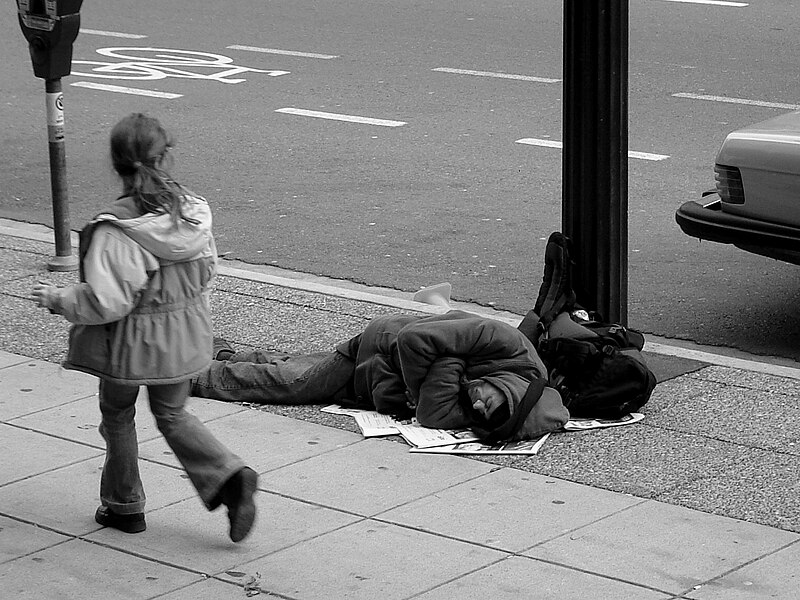
A man sleeps on a Vancouver street
as a passerby looks on
I'm constantly amazed at the number of homeless people on our main streets in Canada. I've lived in Toronto, Kingston, Montreal and Ottawa, and have also travelled to many other midsize and large cities across the country. We have a serious problem on our hands, and it's compounded by the fact that the majority of homeless people concurrently deal with mental health issues. If we're ever going to get a grip on this problem we need to use different, innovative solutions to get things on a path to mitigation and eventual resolution. I'm hopeful this project will produce some positive results and inform new approaches that get people into a safer environment to receive the services they require.

IIMHL delegates in Killarney, Ireland
(source: Martin Brogan)
In the meantime, I have to get myself packed and ready to get on a airplane to stay with friends or in a hotel and be fed well as we face this issue and so many more at the IIMHL events. Understanding my own privilege in all this is a big part of the ongoing struggle. 

But I try my best. And we as a nation must try harder and learn from our international partners about what works elsewhere. People living with mental health concerns in Canada deserve nothing less.

Tuesday, September 06, 2011

Building the Tribe: An Ode to Teachers on the First Day of School

In the crucible that forged us all
That stood at most three stories tall
And housed the minds the future hopes
Successfully jumps through its ropes
A tribe of people wait to see
This slice of our humanity
Approach with skin scrubbed to a sheen
To cleanly face the unforeseen

These last few weeks the tribe has come
Back to the base to be among
Those others who have also learned
That learning is their main concern
And so they prep for new demands
The tests, the bells, the shows of hands
But on this day, as youth arrived
They hoped their plans were strong devised

But now, first class -- it's far too late
To save their lessons from a fate
That calls to mind a crash and burn
Their principals can scarce discern
From flaming wrecks charred crisply black
By vandals waging bold attack
So all that's left is heartfelt hope
That students over time will cope

Too soon the days transform to weeks
Where sickness wears until they're weak
Fatigue sets in and multiplies
Through blood-red shots within their eyes
They know their fate; despite this fact
They waver not, they never slacked
When working in those last few days
Contending with late summer's haze:

So long! to summer school upgrades
For which they pay and are not paid
Farewell! to summer's warming break
And barbecues with sizzling steak
Goodbye! to time spent home at rest
So briefly August manifests
Adieu! so quick you had to go?
September's here to say hello!

So on this day that school resumes
I wanted to take up this room
To hail, salute and send support
To those who write progress reports
And mark all night, and serve all day
Our kids at work, at rest, at play
So teachers -- smile and have no fear
On this the first day of your year

Your job is tougher than some think
So when stress holds you at the brink
Remember this -- when times are hard
We hold your work in high regard
Without compassion at your core
To push our kids to aim for more
The road ahead is dim and bleak --
So never cease to guide and speak.

Monday, September 05, 2011

The Canadian Inferiority Complex, as Expressed Through Hockey by Boogaard, Rypien and Belak

This has been a horrible summer for the National Hockey League. Three of its players known primarily for their pugilistic talents -- Derek Boogaard, Rick Rypien and Wade Belak -- died over the last few months under circumstances that call into question the continued need for fighting in the NHL. The howls from certain people in the public have grown only louder for rules to be changed to ban players from dropping the gloves during a hockey game.

You're probably wondering why I would write a blog entry on this situation. After all, most of my commentary focuses on the political realm or on the art form I practice. In fact, like most Canadian kids I was raised with the notion that hockey is one of the things that defines us as a people. So from that perspective, talking about hockey is intensely political -- especially when the topic is fighting.

From Don Cherry on down there is a large, predominantly Canadian, faction within the NHL sphere who will not countenance a league without fighting. However, as Jack Todd writes, most fights in the league are now set pieces that have little or nothing to do with the actual flow of the action, as fights once did in a bygone era. They are nothing but interruptions, brutish sideshows, and increasingly dangerous ones at that.

The Neanderthals who would keep fighting in the NHL try to argue it's intrinsic to the nature of the game. They espouse the ridiculous notion that people come to games for the fights, they are entertaining, and without them the game will lose its edge. Despite the fact that other equally fast, strength-dependent, violent sports like rugby and football thrive without fighting, and that the international game and the Stanley Cup playoffs get along excellently without fisticuffs, these NHL tall foreheads refuse to listen to reason, or join the rest of us in looking for root causes for the alarming rate at which former and present players are being damaged by injuries such as concussions and fight-related trauma. 

I could write a seriously long entry on all the intricacies of this issue, because it bothers me that much, but let me say this: the way we Canadians view hockey is, in a sense, a reflection of the way we view ourselves. 

For decades, we have suffered from something of an inferiority complex. Canada has never been able to exercise primary policy-shaping influence in world affairs. We have existed as a middle power neighbouring a superpower, and that has played upon our national psyche for a long time. We have always looked for approval from our "big brothers" on the international stage -- first France, then Britain, and now the United States. We have been forced through the dual accidents of history and geography to literally hack an existence out of the wilderness while sleeping next to a proverbial elephant. The society that emerged from this combination of ruggedness and neighbour envy produced a sport for the world -- hockey -- that perfectly reflects this personality.

But times have changed. We no longer need to instigate a fight with others to make ourselves feel bigger, or to catch the attention of our southern neighbours. Canada has enough going for it to gain plaudits for a variety of laudable reasons. In the same way hockey has become an international athletic staple, played at a high level in dozens of countries and recognized as one of the world's great team sports, the originator nation of that game has come over time to stand on its own, independent of past colonial entanglements and respected as an important player on the global stage. 

We as Canadians must relieve ourselves of childish things for we are no longer children. It is grown men who are suffering as the result of the NHL's infantile approach to head injuries and fighting in the league, and these men are orphaning actual children in the vacuum created by league inaction. The NHL claims fans want this paradigm to continue. It's time for all of us to maturely state this is no longer tolerable.

As the originators of the game, and as a mature society, it's on us to demand an end to the suffering. 

Sunday, September 04, 2011

Whither Labour?

Tomorrow is Labour Day, the annual celebration and reflection on the role of workers who, over the decades, have contributed to building Canadian society. I plan to participate in the parade in downtown Toronto. This will be the first time I will participate, even though for most of my adult working life I have been a member of a union.

For me personally, I have had a checkered relationship with unions. While I have worked successfully with the labour movement as a contractor, providing services for both the Ontario Federation of Labour and the Canadian Labour Congress over the past few years, I have not always been able to gain the protections I needed as an employee. When I was a teacher in Quebec, my union let me be pushed out of my teaching position because of a technicality. It was this negative experience that led me to leave the province and move to Ottawa so I could work in Ontario. I found a government job after a few months and the unions that represented me (CAPE and PIPSC) were very helpful to me during the nine years of my public service career.

Ironworkers march in 2008 Labour Day Parade, Toronto ON
I am a strong believer that unions continue to play a valuable role in the marketplace and in broader actions aimed at social justice. At their best, unions are a powerful force for good in Canada, and should be encouraged to strive for those positive contributions at all times. 

There is a debate right now within the New Democratic Party about whether or not unions should continue to hold a special bloc of votes at leadership conventions. In the past, 25% of the votes used to select a leader were reserved for labour. Some in the party wish to maintain this arrangement while others argue it's time for a change.

No matter which way you slice it, in my opinion the NDP will always have a difficult time justifying to the public why labour should wield such influence within a political party. If the Conservative Party, for instance, were to set aside 25% of the votes for any identifiable interest group (business leaders, anyone?), the public and people in other parties would quickly claim the Tories were beholden to a special interest. People in the NDP would be squawking loudest of all.

In this day and age, when corporations and labour unions have been banned from making donations to political parties, allowing unions to vote influence instead of purchase it will be a hard sell. As much as some well-meaning people may want to maintain historic ties, the times have changed. The NDP is no longer a fringe party whose decisions have relatively little impact on the federal scene. The party is now the Official Opposition, and in order to be taken seriously as a true government-in-waiting, the former trappings of protest must be muted or set aside entirely. 

By all means, encourage unionists to be heavily involved in the leadership process. But to have a bloc of votes set aside for an identifiable interest in the modern age would be an unforced error handing the Tories a bat to beat the party with for the next four years.

Saturday, September 03, 2011

The NDP: Aftermath and The Way Forward

I have been thinking of writing a blog post about the passing of Jack Layton for some time now. There were many things I wanted to say about him, but I felt they were being said far more eloquently than I ever could in the actions and the genuine outpouring of grief by everyday Canadians of all political persuasions from coast to coast. From the chalk covering Nathan Phillips Square in Toronto, to the vigils held spontaneously across the nation, to the letters, notes and online expressions of grief, this was a rare unifying moment in our history when our politics were consumed whole by our collective humanity.

This moment was most searing for the followers and members of the New Democratic Party. The loss of a leader so tragically and so soon after his (and his party's) greatest triumph has been a body blow to the NDP. In the aftermath, people have started to move ahead and plan for the next steps in the journey. Next Friday, the national executive will establish the rules of engagement for a leadership contest that will choose someone to replace Layton at the helm. Shortly thereafter, the people currently considering a run at the leadership will weigh the rules, their personal desires, their potential support and fundraising bases, and their potential competition and then decide whether or not to throw their hats into the ring.

And then the NDP will pursue that great task of selecting the man or woman who will take up Layton's work and push the party towards the next federal election in October 2015, all the while working to establish the NDP's newfound second-place status as a stepping stone upward and not as a fluke followed by a crash back to earth. 

NDP MP Thomas Mulcair
In his final message, Layton hoped this race would begin quickly and run about as long as the 2003 contest (which selected him as leader). It's been widely reported that the length of the last contest was roughly seven and a half months. So why are people in the party and in the media tied to this bizarre idea that the race will be concluded by January? This idea has become so prevalent that Thomas Mulcair has already made his first big mistake in this race, claiming he won't run if the leadership convention is held too early. 

Rebecca Blaikie has been tasked by the party's executive to lead the crafting of the rules of engagement. There's simply no way she's going to suggest the party dispense with Layton's final suggestions. So let's do the math: it's September. A leadership race with a timeline of seven to eight months would place a convention in March or April 2012. That's plenty of time to build a campaign, go across the country and meet people, sign up people all over the place (especially in Quebec), strengthen local associations, conduct debates and consultations, and otherwise conduct the business of a party looking for a new leader. 

Hey, NDP supporters -- chill out. Everything will be fine, and there won't be a convention in January.

I personally feel excitement about the process of choosing a new leader. The invigoration of the party at the local level can only bode well for the continued success of the NDP as a political force, and make it harder for the Liberals to try and come back and reclaim second-party status. The NDP will also be out in front of the other parties in the House of Commons that currently lack permanent leaders, and will give that individual maximum time to grow into the role. Jack Layton did not arrive fully formed as the formidable leader he had become by 2011 -- it took years of hard work and dedication for him to get there. The new leader will need similar time, and the stability of a Conservative majority until 2015 actually works in his/her favour in that regard.

This timeframe also permits the party to work towards building a stronger funding base in preparation for the battle ahead with the Conservatives, who are currently biding their time and waiting for things to shake out before unloading their heavy artillery on the new leader. They will try Ignatieff tactics again -- spend lots of money trying to define the new person before they get a chance to define themselves. New Democrats will have to be ready for the onslaught, and the need to build a war chest in the coming months has never been clearer.

I have ideas and perspectives on how this race may come to pass. Until candidates start to declare their official entry into the race I will hold my own counsel. But look for more posts on this topic in the weeks and months to come.

Thursday, July 21, 2011

A Reflection on My Twitter Account, McLuhan & the Art (?) of Poetry Slam

(as originally posted on my Facebook account)

Today at 11:42 a.m., @TOPoetrySlam tweeted: "Wow, just found out poetry slam as an art form turns 25 on July 30...the same night as our slam at The Drake. Kismet!"

That tweet got me thinking about the art that I have been practicing for the past eight years. You see, though I am heavily identified with the Canadian slam poetry community (likely due to my roles as a co-founder of Capital Slam and the Ottawa Youth Poetry Slam, and a representative for Ottawa in the national slam championships in 2004 and 2006), I personally don't identify with the "slammer" label others occasionally try to apply to my work. For me, slam is a means to an end, an entertaining side note in my quest to become a better writer, performer and presenter. I have never written with the end of winning a poetry slam in my mind.

Today at 12:06 p.m., @Ritallin tweeted: "Question for @missie_p @TOPoetrySlam & other poets: Is slam an art form or a form of an art? #slam25 #longlivespokenword"

Some of my poetry ends up being the proper length to perform at a poetry slam, and if I said that wasn't something I checked for once I felt I'd come to the natural ending point of poems I'd written, then I'd be misstating my case. But most of my poems are too short or too long for slam, and that's totally fine by me.

The rush of poetic competition no longer stokes my fire the way it once did. When I first got into poetry slam, I would write like a man possessed, determined to have enough material to share on stage. In those early days, much of what I wrote was straight imitation of what I saw on stage and my efforts to figure out how I could do that myself. And in retrospect, that was probably a good thing. I already had a voice I developed in my hip-hop past, but spoken word opened my eyes to a whole new set of possibilities. I was so eager to do well, I focused on the outcomes rather than the process. Therefore I was doing fairly well in competition, but my writing wasn't truly expanding.

All that changed after I went to the 2005 Canadian Festival of Spoken Word in Vancouver. It was after that experience when I first fully began to understand the potential in what I was doing. Slamming at the Wordlympics in Ottawa the previous year had tuned my slam ear; watching the national slam finals and featuring in a showcase in Vancouver showed me how far my writing still had to go. And though I would go to slam at CFSW the following year in Toronto, never again did I choose to measure myself against the cliched and trite standards of the slam format.

After Vancouver I started to do more feature sets, write more free verse, experiment with different ways of writing, and produce merchandise. I folded my hip-hop background into my new ways of exploring words. I stopped being afraid to talk about personal experiences and wrote pieces that exposed my emotions and spirit in ways I previously could never have imagined. I started working my craft and organizing my output. In short, I matured as a spoken word artist. Today, I will not be called anything else in a poetic sense.

I am not a slam poet. Don't get it twisted.

Today at 12:07 p.m., @RustyPriske tweeted: "@Ritallin @missie_p @TOPoetrySlam Slam is the medium, and this is Marshall McLuhan's 100th birthday..."

Ah yes, slam is definitely a medium of expression that continues to grow in influence and popularity. Ever since Marc Smith got things going in Chicago a quarter-century ago, poetry slam has spread around the world. There are competitions in numerous languages on multiple continents. Some poets are now touring the world partly or mostly due to success in the poetry slam format, wherever they hail from originally. There is a World Poetry Slam Cup competition every year in France (where coincidentally Canadians have dominated for the last two years). And our national finals have grown from eight teams representing five cities in 2004 to eighteen teams representing fifteen communities in 2010. We even have a slam scene based in rural Lanark County, Ontario that regularly sends teams to compete in nationals.

Today at 12:12 p.m., @Ritallin tweeted: "@RustyPriske @missie_p @TOPoetrySlam @dwayne_morgan Slam might be the medium & the message, but it's only a form of the art #spokenword"

What is the message in all of this? Poetry slam is strong and vibrant, impacting and affecting poets and the people who come to witness the competitions no matter where in the world the competitions are taking place. I think that's why some have come to the conclusion that slam is what we should aspire to perfect -- that it is an end in and of itself. I'm sure some truly believe that, but I'm not in their number.

I see slam for the populist gimmickry it truly is -- a high-energy, often superficial, sometimes problematic, often predictably formulaic, usually entertaining method of putting bums in seats to support a poetic community. I love it as an incubator for fresh young (and older) writers getting their feet wet in literature and in performance. It's a great place to get started, but there's so much more to the oral literature we practice than hunting for 10s from random strangers.

Today at 12:17 p.m., @RustyPriske tweeted: "@Ritallin @missie_p @TOPoetrySlam @dwayne_morgan It isn't even a form. It is just a competition. The art is what happens DURING the Slam."

Exactly. And the art we practice is spoken word -- in all its forms.

Friday, June 24, 2011

Bon Fete, Quebec!

Today is St. Jean Baptiste Day in Quebec. Partygoers across the province will celebrate their "national holiday" through parades, commemorative events and social gatherings. This is a big deal to our French Canadian brethren -- this tradition can be traced all the way back to ancient France. The first-ever celebration of the day on Canadian soil was in 1636, during the earliest days of the colonization of New France, and the first patriotic celebration of the feast day of St. John the Baptist took place in 1834 in Montreal. Pope Pius X designated John the Baptist the patron saint of French Canadians in 1908, and June 24 became an official holiday in 1925. 

But it was the Parti Quebecois led by Rene Levesque that made June 24 the province's national holiday, thereby tinting the celebration with a political hue that hasn't dissipated since that decision was made in 1977. Throughout the separatist era, the sovereigntists have used Jean-Baptiste as the ultimate expression of their continued desire for statehood -- a muscular exposition of their drive for an independent state.

Sadly, most Quebeckers are disinterested in reigniting the referendum flame. The Bloc Quebecois are in a shambles and utterly irrelevant in Ottawa, the PQ is a leaking ship and plummeting in the polls, and a new political movement led by former PQ cabinet minister Francois Legault is the odds-on favourite to take out Premier Jean Charest's Liberals when the next provincial election is held. 

Legault's pitch? The battle for sovereignty is so 1995. People in our province have more immediate concerns that impact their families, businesses and communities. We need to keep Quebec strong, today. Let's get on with it, d'accord? 

So it is in this spirit that I raise a toast to my Quebecois brothers and sisters. Here's to you having a peaceful, free-spirited and enjoyable holiday. May the French Canadian fact in our country continue to play a strong role in the present and future of Canada. Vive le Canada! Vive le Quebec dans le bon pays du Canada! 

Did I say that right? Pardon my French!

Wednesday, June 22, 2011

Is There A (Spin) Doctor in the House?

Man, these guys are good.

In the Globe today, the Tories go after former Liberal MP Marlene Jennings, the person who instigated the RCMP investigation into the G8 Legacy Fund -- the big, sloshing pot of cash Harper cabinet minister Tony Clement liberally showered across his riding (ostensibly) in preparation for the summit held in Huntsville last year.

The way the Tories manipulate information is frighteningly impressive. After accusing Jennings of a "publicity stunt" and the Liberal Party of employing "cheap, baseless drive-by smears," they then seek to completely obscure the core issue of the G8/G20 controversy. The article ends with:

Tory memo concludes that Auditor-General John Wiersema “was clear when he said that he was ‘not aware of any specific law that was broken.’

“Every penny is accounted for, not one red cent is missing,” the memo says. “Mr. Wiersema acknowledged this when he said ‘we know that we got what we paid for in those 32 projects.’”

Indulge me for a moment as I parse these two statements:

1) It's wonderful the Auditor-General is unaware of any laws being broken. I'm not aware of it either, but the Tories won't crow about that in a memo, will they? Wiersema's opinions are completely irrelevant on legalities. He's an accountant, not a lawyer or a police officer. Which is why the RCMP is investigating if there are any illegalities that stem from this nasty bit of business.

2) We all know the money was spent. No one has attempted to say that it wasn't. It's great the government can account for every penny, but the problem isn't missing funds. The real issue is whether that money should have been spent that way in the first place. Spending money inappropriately or illegally is still inappropriate and/or illegal even if you can trace every penny of it.

This memo is spinning so hard I feel like I'm on a Tilt-A-Whirl -- and the last time I did that I was immediately ill when I stepped off.

Kind of how I feel when I read this drivel from the Conservative Party.

Saturday, May 28, 2011

On Public Subsidies for Political Parties

In the upcoming federal budget, the newly-minted Conservative majority will initiate the phasing out of public subsidies for political parties.

This move has been coming for some time. Ever since the Tories first tried to do it in 2008, and in the process spurred a crisis that almost cost them government, they have been waiting for the chance to chop the transfers to the opposition parties. Of course, their piece of the $27 million pie will also disappear, but Harper's party has become much better at fundraising than the others since the current funding regime was put in place by Jean Chretien in 2004. The NDP aren't terrible at it, but still do not do as well as the Tories. The Liberals, however, are abysmal at raising money from individuals, and therefore stand to lose most from the elimination of the $2 per vote subsidy (unless you're a supporter of the Bloc Quebecois, who, as I've previously argued, are on the verge of extinction partly due to their money woes).

Individual contributions to political parties are currently permitted to a limit of $1,100 per person per year. For this measure to make any sense at all, this limit must be raised to give parties a fighting chance at replacing the lost revenue once the subsidies are gone. As Jeffrey Simpson points out: "Transparency, a higher individual limit and the end of public subsidies would be a reasonable compromise. But, of course, the Conservatives with their majority are not looking for compromise." Harper wants to use the baseball bat of his majority to kneecap his competitors -- especially the flailing Liberals.

I believe the Tories should be very careful they don't get exactly what they wish for. By tilting the playing field so boldly and obviously in their own direction, they risk incurring the wrath of the public over time. The subsidy will be gone in time for the next election, meaning the annual infusions will play a reduced role in campaign preparations for the October 2015 election than it has in the past few campaigns. If the Conservative Party of Canada means to use a perceived advantage to attack its adversaries through spending dollops of cash on negative pre-election ads in 2014 and 2015, the public may finally revolt.

If any lesson can be learned from the Orange Crush this year, it's that Canadians are tiring of the old tactics and want a different political environment. The Tories would be wise to heed that lesson, lest they start turning their perceived advantages into tangible liabilities at the most inopportune moment.

Friday, May 06, 2011

The U of T, or the Usefulness of Thought

Douglas Library, Queen's University
Today I will be travelling to Kingston, Ontario to attend the annual meeting of the Queen's University Council. I was elected to serve a six-year term on the body last year. Unique among the nation's universities, the Council brings together members of the Board of Trustees and the Senate, along with elected alumni representatives, to provide advice and guidance to the Chancellor. It is the highest body in Queen's governance structure.

In practical reality, the Council is a gab-fest where we talk about what challenges and opportunities are coming the university's way and provide ideas on how to address them. Depending on who the Principal is, our advice is either incorporated into decision making, or not. There's no requirement that our thoughts must be brought forward beyond the confines of our meeting room to affect the life of the broader university.

Massey College, U of T
My trip back to Queen's is causing me to reflect on Micheal Ignatieff's appointment as a senior resident at the University of Toronto's Massey College. After suffering a defeat for the ages in Monday's election, he wasted no time in finding somewhere to go. Ignatieff returned to the ivory tower, where he will never again have to personally test his ideas in the brutish real world of Canada's political theatre. He certainly has learned lessons about the disconnect between political theory and the reality of life at ground level; hopefully he can impart some useful wisdom on a group of graduate students that includes many with interest in politics as a future career.

History will not be kind to Ignatieff. Many thought the Liberal Party had bottomed out with Stephane Dion's leadership in the disastrous 2008 campaign. Unfortunately for them, it seems there was much further yet for the party to fall, and Ignatieff will always be known as the guy who led them there. The Conservative charge that he was in it for himself all along isn't helped at all by the following two quotes from the Globe and Mail:

“The life that I like the best is teaching. It’s the end of my life as a politician.”

“I’m quite excited about the next phase of my life. Without blowing my horn too much, there’s not too many people who have been full-scale academics and who’ve also been the leader of a political party. It’s a special experience."

These quotes give the impression that Ignatieff never warmed to politics, and that he has decided to use his Liberal party leadership experience as a résumé-padder. Ironically, Canadians could tell that he never had the right stuff for the game, and that he didn't ever truly understand them or their issues. I believe Ignatieff is an honourable guy who worked hard and tried his best to lead his party in the best way possible. But he never should have left Harvard, if these two quotes can be taken at their face value.

Le petit gars
Jean Chrétien
Canada needs more than a leader looking for a "special experience." They need someone who has the passion for the country bred intangibly into their bones. For all their faults and shortcomings, you never felt like people such as Ed Broadbent, Joe Clark, Jean Chrétien or Preston Manning lacked those qualities. Even current leaders like Stephen Harper, Jack Layton and Elizabeth May clearly connect with their constituencies and could never be accused of lacking a deep commitment to Canada (even though their conception of what Canada is and should be diverge, sometimes widely). But you never got that impression consistently from Ignatieff. It often looked like an academic exercise to him.

The passion only truly came out when he became desperate in the latter stages of the campaign, as his dream of becoming prime minister disintegrated. And passion borne of desperation cannot be taken at face value.

So when I head out to Kingston tonight, I'll be reading the pertinent documents and arranging my thoughts on the various agenda items for the meeting tomorrow. I go to Queen's knowing my ideas and perspectives will be listened to, but not necessarily acted upon. My advice may be seen as crucial, or heard only as so much noise. But I go, and have been actively involved in the university's governance since 1996, because I believe giving up on Queen's will only remove one more voice that might help it achieve its mission that much more ideally.

Michael Ignatieff will give his advice and guidance to the students of Massey College over the next year, in the hope they may go forward from U of T and help Canada become a stronger, more compassionate and more respectable nation, both domestically and abroad.

I take him at his word when he says:

“And there's some things you learn when you've done it, and it’s just not in the books. I did it. I've lived it. And I know what's in the books isn't what it's like. Everybody who's done it knows that it's really different – and you want to tell [students] that, not to discourage them from public service but to get them to commit, and take the risks involved. I'm very keen on using the time I've got to get people into the game.”

Bob Rae (l) was once a senior resident
at Massey College after a political
flame-out of epic proportions, too
There's an earnestness, tinged with bitterness, in these words that I think will serve his students well. I wish him the best of luck as he retreats to academia and a quieter life than the one he knew as a politician.

There's no requirement students bring forth his ideas from the university and into the public sphere with the aim of positively affecting the lives of Canadians. But if one student can learn the lessons and find a way to apply his principles for a more advantageous result for all of us, then perhaps his life's passion can find its best expression in that way. For his sake, and the sake of our country, I hope that is possible.

Change to the Look of PS&R

I decided the site was in need of a refresh, so I flipped up the design and changed a few small aspects of the layout. I hope you like the new look!

Thursday, May 05, 2011

Barbarism and Sacrifice

Two significant news stories today that, at first, seem related in only a peripheral way, have come together in my thinking. The first is U.S. President Barack Obama's decisions not to release photos of Osama bin Laden's corpse, and to travel to New York today to lay a wreath at the site of the destroyed World Trade Centre. The second is the death of the last surviving veteran of World War I in Australia.

In a world of raging armed conflicts, devastating natural disasters, horrendous social and political upheavals, oppressive dictatorships and epidemic disease, it's amazing to me how much we can concentrate on whether or not we are entitled to see a blasted hulk of human flesh captured on a digital camera. Whether you believe the Americans or think they are lying (a discussion I don't want to get into), I find it reprehensible that people are actually celebrating murder like it's their daughter's fifth birthday party and she just opened all her presents. I find the lack of respect for the death of another human being to be galling.

And yes, the person in this case is bin Laden. I get that he's the world's most wanted man, a terrorist who inspired and supported the mass murder of thousands of people on U.S. soil in September 2001. He's not Mother Teresa. I'm not a fool, I know he's not a sympathetic figure. But what does it say when we can't even restrain ourselves enough to be more muted in response to news of his assassination?

Are we barbarians?

By comparison, the death of Claude Stanley Choules is receiving very little fanfare. He was the last known living combatant from the Great War, a conflict that was our first experience with total war. People like to say that our soldiers who fought in the trenches along the Western Front, and the ones who sacrificed so much to fight in the Second World War as well, did so in defense of our rights and freedoms. They were noble warriors, sent to do a dirty job that needed doing, and we should never forget their sacrifice.

Based on what I saw in the news media over the last couple of days with respect to bin Laden's assassination, however, I think we've already forgotten. The pursuit of liberty and peace is never easy, nor always tidy, but we should never try to attain it at the cost of our humanity. Photos or no, I believe the actions of people in the West are provocation enough for those who feel we are dancing on a dead man's grave.

Our history, principles and moral code, if we truly value them, would be better protected if we were less self-congratulatory and more sober in our response to bin Laden's murder. Claude Choules and others like him didn't risk their lives so we could behave like this. We should strive to do better than to stoop to the level of common thugs while seeking a higher purpose.

Wednesday, May 04, 2011

Evaluate, Pontificate, Consolidate

Now that the voting is out of the way and Canadians have delivered a verdict that surprised even themselves, I see a few themes emerging in the coming days and weeks:

- The Liberal Party must go back to the drawing board and figure themselves out. Whatever they've been peddling since the retirement of Jean Chretien simply hasn't cut it, and with Michael Ignatieff's resignation, they enter yet another period of soul-searching. For their own sakes, they better actually do the hard work this time. Canadians don't feel like they owe Liberals anything. It appears as if that news was a shock to Canada's "natural governing party" but it's been that way for four elections now. It took a LONG time for the message to sink in. Perhaps being reduced to a rump presence in Parliament will finally do the trick! The lesson is clear -- if they want electoral success in the future, they're going to have to earn it.

- The Bloc Quebecois is finished. I've put forward practical reasons why a revival is unlikely, so it will now fall to the NDP to find a way to incorporate their voices into the traditional structure of their party. If there is a single organization that will have to adapt more adroitly to the new political reality than the New Democratic Party of Canada, I'd like to see it. And before you say the Liberals, consider this: the NDP beat their previous best of 43 seats in 1988 without factoring in their Quebec seats. With 44 seats in English Canada and 58 seats in Quebec, in a party that has never before elected more than one Quebec MP at a single go, working out the potential differences within the caucus will be Layton's most difficult managerial task.

- Now is not the time for the Conservatives to go rogue. For five years, Harper and his gang have run roughshod over their opponents, the rules and protocols of Parliament, and even the basic principles of democracy itself. Incredibly, and primarily due to the utter failure of the Liberals to propose anything of substance that Canadians would accept, they have been handed a majority mandate. They need to remember that even though our first-past-the-post voting system gave them a majority of seats, three-fifths of voters wanted someone else to govern. They should see this situation as both an opportunity and a very dangerous situation. If they blow it by going overboard, they will ruin their chances at governance for a generation. If they get it right, they can stay in government for a long, long time to come.

All parties need to take a few days to consider the implications of the vote on their political fortunes. Internal party officials will discuss next steps and the leaders will dole out Cabinet or critic roles as appropriate. New strategies will be created and implemented. Staff will be hired. Research will be conducted. And the Tories will craft a new Speech from the Throne to officially announce their agenda for the first parliamentary session featuring a Tory majority since Kim Campbell went to the polls in the summer of 1993.

Once the evaluation of their new situations is completed, the parties will have to spread their messages within the electorate. I believe the Tories will start to fight the next election right away. Their strategy will involve emphasizing the national nature of the party's representation as a launch pad to govern for all Canadians (or at least that's how the propaganda will go). Meanwhile, the Ontario gains and Quebec losses will become the focus, since it is only by retaining seats in the province that gave them their majority that they can rule in the long term. And part of that calculus involves dealing with Quebec well, and fairly.

They will get a bit of help in that respect from the NDP, since this will be a shared objective of the Official Opposition. As Jack Layton moves ahead, goal number one must be to get the greenhorns in his Quebec contingent up to speed and hard to work in their constituencies. The key to future success for the NDP will be how well they can serve locally and how well they can advocate in Ottawa for the province that put Layton in Stornoway. Beyond that, reconciliation of their French and English objectives will also be a critical task. Other parties in the past have imploded over such tensions, mostly on the right flank of Canadian politics (Social Credit in the 1960s and the Progressive Conservative Party in the 1990s are the two main examples). This particular accord is a completely new political arrangement in Canadian politics. How adroitly Layton navigates this potential minefield while attracting a broader following from progressives across Canada will dictate his chances of defeating Stephen Harper in 2015. 

The Bloc may try to revive itself. It is tough to say exactly how they will do that, but I don't anticipate them disappearing immediately. Their most likely fate is a gradual fade into irrelevance. The only thing that can save them is an NDP failure to connect electoral success with strong representation of Quebec's interests in Ottawa. If the NDP is even at least partially successful, the future for the Bloc is bleak indeed.

The newest party to elect a representative is the Green Party of Canada. Elizabeth May invested the party's political future in winning her riding. Now that there is a majority Harper government, however, the main source of funding for her party is about to be cut off -- the per vote subsidies the Tories have vowed to end. And without a minority, her vote can never be the deciding factor in a vote, which also limits her potential impact. The key to future success for the Greens is in electoral reform, a cause that over time is increasing in popularity within the electorate; however, the real job will be to vastly increase individual donations and improve the party internally to prepare for 2015. Expanding on their electoral beachhead must be the focus for the next four years.

And finally, the Liberal Party of Canada needs to listen to Rob Silver. He and I are in agreement that the Liberals are not a left-wing party, and a merger with the NDP is nonsensical. I look forward to reading his perspectives on where he thinks the Liberals should go in the future. My thoughts are fairly straightforward: the Liberals have one chance left, only one more chance, to make themselves relevant to Canadian politics. Grit partisans need to forget about a focus on history. If they do that, they will be history. No, the path to revitalization is reinvention. Anything less than that is disaster. Liberals didn't lose in 2008 just because of Dion, they lost because the Tories have evolved with the times and changed their approaches accordingly, while the Liberals keep fighting the last war. They learned nothing from that historic debacle, and had to suffer an even greater humiliation to hopefully get the message. Another re-run of this mess and there will be nothing left.

Canada is tired of Liberal arrogance when it comes to holding power, and will never elect them again if that air of entitlement lingers a moment longer. The task is daunting, the need for leadership and determination acute. Who will lead this effort? Without the answer to this question, it's hard to see the road ahead at this stage. But that's the biggest concern for the party today. The search for the next leader should be a fascinating one.

We are in uncharted waters for all the parties. Watching it all unfold will be fascinating. But the party best able to execute their plans to achieve their most necessary goals will benefit most four years from now, when Canadians will next go to the polls to elect a government. The 41st Parliament promises to be one of the most intriguing in our history. Don't go back to sleep. Keep paying attention.

It's going to be one heck of a ride.

Tuesday, May 03, 2011

Practical Reasons Why the Bloc is Dead

The Bloc Quebecois is in its final death throes. Here's why:

1. Leadership

Bloc Leader Gilles Duceppe went down to defeat in his riding, along with nearly everyone else in his caucus. The disastrous BQ campaign can be attributed to a lack of energy, purpose and cohesion, and the person who has to take the lion's share of the blame is Duceppe. There was no way he could have remained as leader, even if he'd pulled out a win in his seat. The first Bloc MP ever elected to the House of Commons is done.

But the bigger reason why the BQ's future is so hampered by his loss is due to a lack of a clear successor. Duceppe has taken up so much of the party's oxygen over the years that there is no heir apparent to his deeply corroded crown. Plus, with the repudiation coming from all sides of their traditional support base (both nationalist and sovereigntist), they have virtually no policy room to argue for their continued existence.

The first crisis this party faces in the aftermath of their historic annihilation is their utter rudderlessness.

2. Loss of Official Party Status

In the Canadian Parliament, a party must win 12 seats in order to be officially recognized. With just four seats, the Bloc now falls short of this standard. It is a heavy blow for their party; without it, they do not have the right to participate in the House during Question Period, nor do they have access to funding for staff and research afforded only to officially recognized parties. This development will starve them of attention through QP and greatly limit their ability to efficiently gather resources to conduct House business. In short, they can't do much in the House of Commons as elected MPs.

3. Political Contributions Will Plummet

As a result of becoming a non-factor in the House, there is little incentive for Quebec business or individuals to contribute financially to the BQ's upkeep. They cannot claim to represent the province's interests in the House anymore -- not when the NDP owns more seats in Quebec than they ever did in their two decades of existence. All that money will divert from the Bloc and start to flow into NDP coffers, which should give them to opportunity to marshal resources into the province on a scale they could never reach previously. Since the NDP will want to be in Quebec for the long term, it's logical they will invest significant capital into building an efficient electoral machine in the province.

The research money the NDP will get is about to get a generous bump upwards as well, since such funding is doled out proportionally based on the size of a party's caucus. When the guys replacing you will have three times as much cash as they did before to do what you used to do, the writing's on the wall. And if you can't get your friends to give you the cash you need to fight back, the battle is a hopeless cause.

4. And the Coup de Grâce ...

Stephen Harper declared last night that his government would get back to work today. There are a number of items on his to-do list in the first 100 days, most notably his commitments to pass his budget and re-introduce his crime agenda in the Commons. But also high among his priorities is his determination to end per vote public subsidies for political parties.

The Conservatives have argued these subsidies artificially prop up the BQ and remove any urgency from its external fundraising efforts. So the removal of the subsidies will starve them of financing critical to any attempt at rebuilding the party.

In 2010, the Bloc raised $834,762 in direct donations from individuals, but collected $2.8 million in per vote subsidies.

I've already said their donation base is about to shrink dramatically.

You do the math.

A Quick Comment on Election 2011

As the votes continue to be counted, the seat count at this exact moment is 166 Conservatives, 103 NDP, 34 Liberals, 4 Bloc Quebecois and 1 Green Party MP. 

It is a truly amazing result. The Canadian electoral map has been completely redone. This election is a watershed moment in our political history.

I will have more analysis after the results are more solid. But let me signal one thing that I will be exploring in the days ahead -- the assumption that there is a left-wing split in this country between Liberals and the NDP. John Ibbitson wrote a response article about the election results, arguing this point. He wrote that now is the time to combine the parties, and merge Canada's two left-of-centre parties.

This is wrong. The Liberals are NOT a left-of-centre party. But if they want to be taken over by the NDP, they should feel free to propose it. 

Now is not the time for Jack Layton to even entertain such a proposal. Most progressives reject outright that the Liberals can be counted among their ranks. We will see what the Liberals do next, and how long Ignatieff will remain at the helm, but an NDP/Liberal merger can only happen on NDP terms at this point, which is exactly why the Liberals will never do it.

Let's give Layton and his team the next four years to strengthen themselves as a true government-in-waiting and then see what voters think. The people of Canada are sick of the pundits and the Liberals telling them what they should think.